Welcome to the Mathematical World!
Alan Turing
The Father of Modern Computing
Not to be confused with Alan Walker!!! (Clickable Link)
Alan Mathison Turing (1912–1954) was an English mathematician, logician, cryptanalyst, and computer scientist. He is widely regarded as the father of theoretical computer science and artificial intelligence. Turing’s pioneering work laid the foundations for modern computers and significantly influenced cryptography during World War II.
Early Life and Education
Turing was born in London, England, and displayed exceptional intellectual abilities from a young age. He excelled in mathematics and science, eventually studying at King’s College, Cambridge, where he became a Fellow for his research in probability theory and mathematical logic.
The Turing Machine and Computability
In 1936, Turing introduced the concept of the Turing Machine, an abstract device capable of simulating any algorithmic computation. This idea formalized the notion of computability and is central to theoretical computer science. The Turing Machine consists of:
- An infinite tape divided into cells
- A read/write head that moves along the tape
- A set of rules defining state transitions
Mathematically, the machine operates by reading symbols \( s_i \) from the tape, changing its state \( q_j \), writing a symbol \( s_k \), and moving the head left or right, following a transition function:
\[ \delta: Q \times \Gamma \rightarrow Q \times \Gamma \times \{L, R\} \]where \( Q \) is the set of states, \( \Gamma \) is the tape alphabet, and \( L, R \) denote head movement.
Codebreaking and World War II
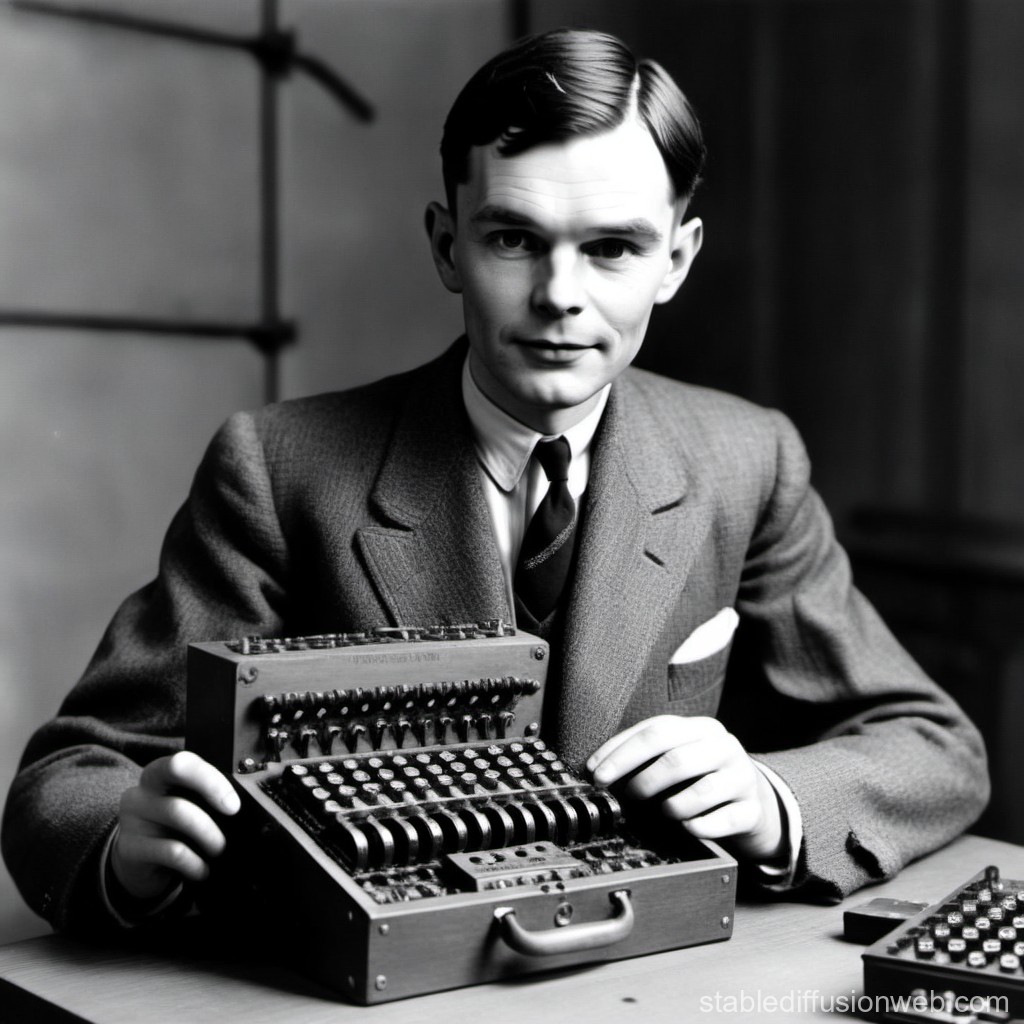
During World War II, Turing worked at Bletchley Park, leading efforts to break German ciphers, particularly the Enigma code. He developed the Bombe, an electromechanical device that helped decrypt Enigma messages, significantly shortening the war and saving countless lives.
Artificial Intelligence and the Turing Test
Turing also proposed the concept of machine intelligence. In 1950, he introduced the Turing Test as a criterion for evaluating whether a machine can exhibit intelligent behavior indistinguishable from that of a human. The test involves an interrogator communicating with both a human and a machine without knowing which is which; if the machine can convince the interrogator of its humanness, it passes the test.
Legacy
Turing’s contributions form the foundation of modern computing, artificial intelligence, and cryptography. Posthumously, he has been honored in numerous ways, including the naming of the Turing Award, the highest distinction in computer science. Turing’s life and work continue to inspire scientists, mathematicians, and engineers worldwide, embodying both genius and profound social impact.

All rights reserved by the Mathematical Unity
Contact: +8801400044645
Email: mathematicalhorse1453@gmail.com
Our Discord Server: Mathematical Unity [Ulus Riyadiyat]